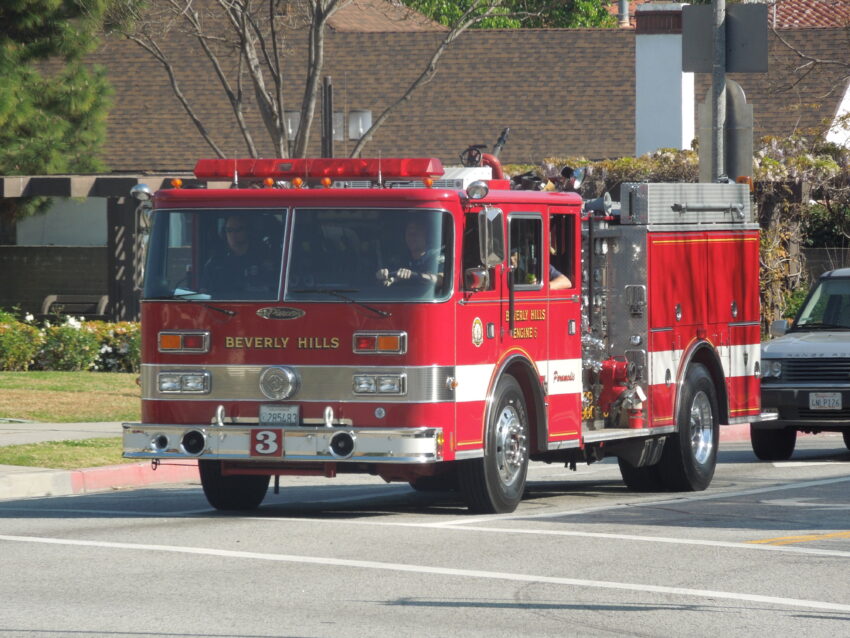
BEVERLY HILLS, CA — The city covers 5.71 square miles. On a busy day, far more people pass through it than live in it, and the fire department carries that load. Beverly Hills became a city in 1914, and its emergency services grew up with it.
That daily tide lands on one department. The Beverly Hills Fire Department protects about 34,000 residents and an estimated 150,000 to 200,000 visitors who arrive each day.
Three fire stations answer every call.
The department handled more than 8,600 incidents last year. That works out to roughly 24 calls a day.
Three stations, one small map
Station 1 is headquarters, at 445 North Rexford Drive in the civic center. Station 2 serves the hills from 1100 Coldwater Canyon Drive. Station 3 covers the eastern edge from 180 South Doheny Drive.
Crews at all three stations don’t close up shop. They rotate through A, B, and C shifts on 24-hour days, with two on and then four off.
That schedule works out to 56 hours a week for every shift.
The department answers more than fires. It also takes non-emergency service calls. Alarms and public assistance fall into that bucket.
Beverly Hills holds fewer residents than a single Los Angeles neighborhood. Its daytime crowd rivals a mid-size city, and that mismatch drives the workload.
Protection-area population
The gap between those numbers shapes the job. Commuters, shoppers, and hotel guests fill the streets each morning. They drain away again each night.
Fire and medical calls track that daily swell.
Sixteen rigs, three bays
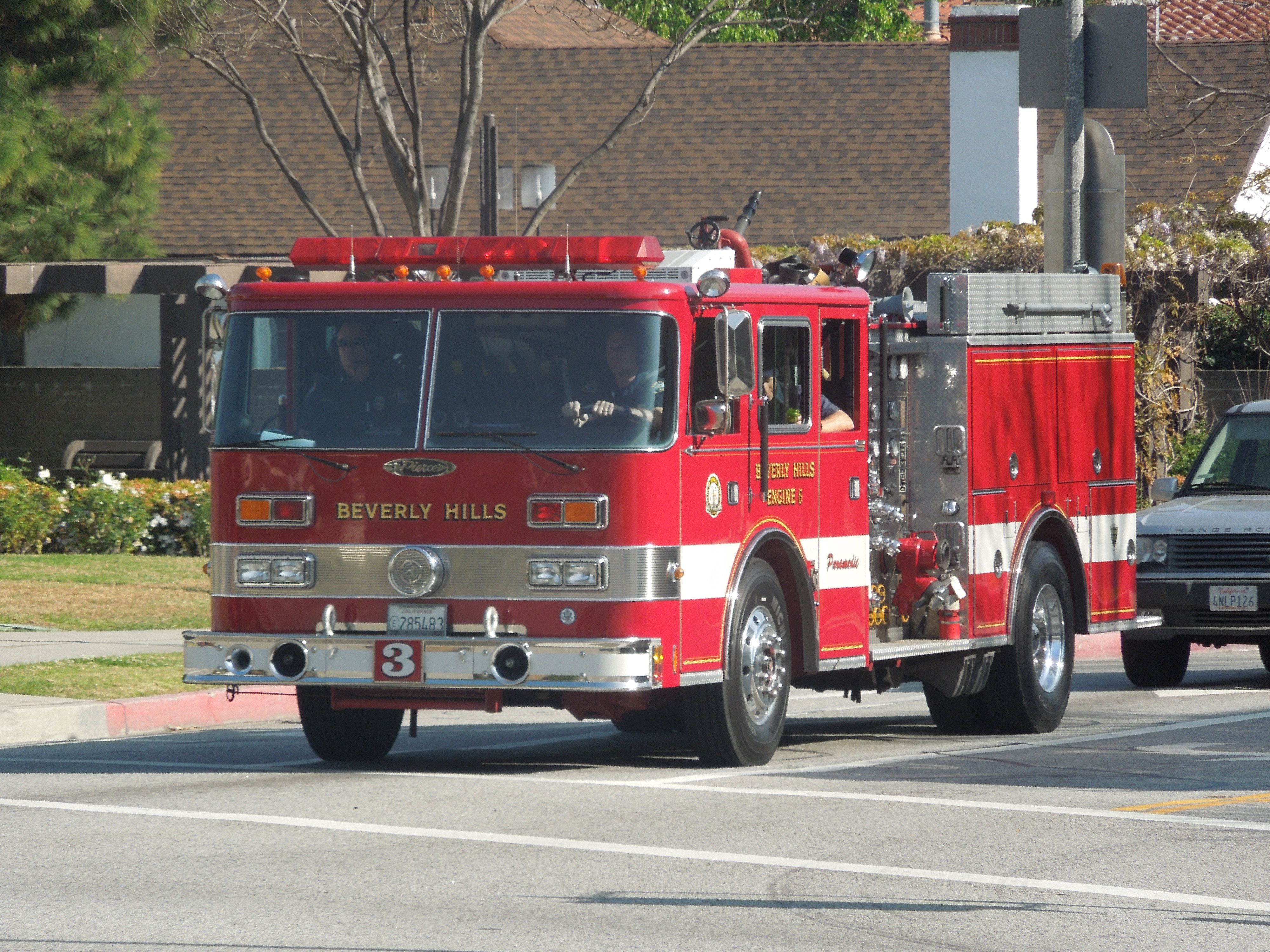
The department keeps 16 active and reserve apparatus. Headquarters holds the specialty rigs: Battalion 1, Engine 1, Truck 4, Engine 5, Rescue 1, Rescue 801, and an urban search-and-rescue unit.
Engines carry water and hose for structure fires, while trucks bring ladders, tools, and a rescue crew.
Stations 2 and 3 each house an engine and a rescue. Both sit near the city’s edges. That placement keeps response distances short.
Battalion chiefs work out of headquarters. They run operations across all three stations during their shift.
A Community Risk Reduction team handles inspections, fire permits, extinguisher programs, and building safety.
A staff of 123 firefighters and civilian personnel runs the operation, led by Chief Gregory Barton. The city’s police force grew up alongside these crews, a story we traced in our look at BHPD history.
A Class 1 rating
The Insurance Services Office grades departments on how well they can defend a community. Beverly Hills carries the top mark, a Class 1 rating. Few departments nationwide hold that grade.
The city pairs the rating with accreditation from the Commission on Fire Accreditation International. Both marks feed into what property owners pay for insurance.
The grades rest on steady drills, inspections, and equipment checks.
| The department at a glance | |
|---|---|
| Stations | 3 |
| Residents protected | about 34,000 |
| Daily visitors | 150,000 to 200,000 |
| City area | 5.71 square miles |
| Calls a year | more than 8,600 |
| Firefighters and staff | 123 |
| Apparatus | 16 active and reserve |
| Fire chief | Gregory Barton |
| Insurance rating | Class 1 |
Beyond fire, the medical calls
Emergency medical service runs around the clock. Firefighter paramedics staff every hour of the day. Their training reaches well past basic first aid.
Most calls are not fires at all. The department answers every medical call with both emergency medical technicians and paramedics.
An Advanced Provider Unit pairs a nurse practitioner with a paramedic. The unit handles urgent care in the field. It also covers mental health and social service visits.
The department runs its own ambulances and bills for transport. A designated officer tracks infection control and patient records.
Firefighter paramedics deliver advanced care at the scene. The work includes intravenous medications, cardiac defibrillation, and breathing support. Every firefighter also trains in advanced first aid and CPR.
A Mobile Stroke Unit sits on the service list too.
The department also joins Los Angeles County’s Community Connect program. It lets residents share household details ahead of time. Crews can then see what to expect on arrival.
An EMS registered nurse leads the program. A board-certified emergency medicine physician backs the clinical review.
Wildfire risk in the hills
Beverly Hills is a dense city, but its hillside blocks sit close to open land. Dry brush there can carry fire toward homes. Strong wind does the rest.
The city joined the Firewise Communities program to cut that risk. The program covers brush clearance, fuel modification, and home hardening.
Firewise asks a community to invest at least $2 per person each year. It also requires a yearly progress report. A spring work day rounds out the deal.
The city’s home hardening guidance covers vents, roofs, and windows.
Crews also pre-plan high-risk buildings before trouble starts. They map access, water, and hazards for each one.
A Community Wildfire Protection Plan is now in development. The city’s building it with CAL FIRE guidance. A public survey feeds into the draft.
Practice, and a look inside
The city will run a local evacuation drill on November 8, from 1 to 4 p.m.
A temporary shelter and checkpoint will sit at Will Rogers Memorial Park. Residents picked for the exercise get their notice by mail.
Two community meetings cover the details ahead of time. They fall on October 21 and November 4 at City Hall. Both start at 6 p.m.
The drill walks residents through wildfire, earthquake, and hazardous-materials scenarios.
The city’s go-bag checklist groups the essentials under six P’s. They run from people and pets to papers, prescriptions, and pictures. Plastic, meaning cards and cash, makes the list too.
The stations welcome visitors each day, from 10 to 11:30 a.m. and again from 1 to 4 p.m. Tours depend on whether crews are out on a call.
The department also hires through the city’s human resources page.
The city holds a Fire Service Day open house on the second Saturday of each May. Two smaller details surprise people. The department doesn’t install child car seats, and it won’t send an engine to a birthday party.
It also pays to register for city alerts before you need them.
The alert system already covers landline phones by default. Cell numbers and email addresses need a short sign-up, and the city also broadcasts on radio and local cable.
Emergency alerts by text
Add a cell phone or email at the city’s emergency notification page.
Text BEVHILLS to 888777 for city alerts. Text BHPDALERT to 888777 for police alerts. The disaster hotline, 310-550-4680, opens only during an emergency.
Sources: City of Beverly Hills pages on the Fire Department, its stations, apparatus, and emergency medical services. Also the city’s alert systems and wildfire program pages, plus the 2026 Beverly Hills Evacuation Drill notice. All at beverlyhills.org.