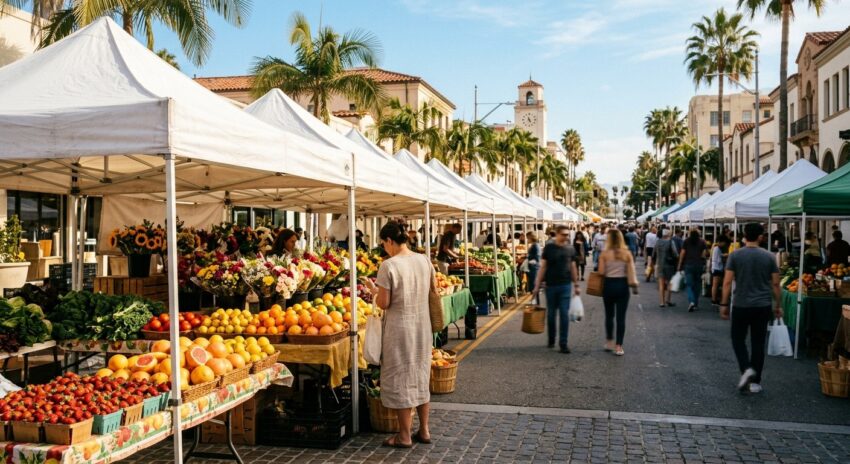
BEVERLY HILLS, CA — On Sunday morning, a city that lives on camera sounds like a produce stand. Tents rise along a closed stretch of Civic Center Drive before most of the town is awake. By eight, the Beverly Hills Farmers’ Market is open.
It runs every Sunday from 8 a.m. to 1 p.m. Rain or shine. All year long.
The market is a certified one, which is a promise with teeth. Vendors grow what they sell. Nothing here came off a truck from a warehouse in the middle of the night.
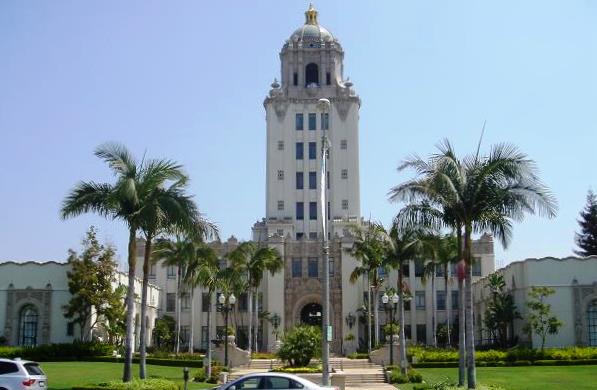
A market in the civic district
The address is plain. The market runs along the 9300 block of Civic Center Drive, between Third Street and Santa Monica Boulevard. That is the flat, bureaucratic heart of the city, not the postcard part.
Then the tents go up and the block changes. White canopies stretch down the street in rows. Tables hold citrus, strawberries, leafy greens, and flowers cut from California farms that same week.
The morning light is low and gold. It catches the wax on the fruit and the steam off the coffee cart.
There are juices, baked goods, and specialty items too. The smell of fresh bread travels further than any sign.
For a few hours, the city’s most formal street becomes its least formal place.
Part of that is the setting. The civic district is where residents already go to do the boring work of a city. They pay a water bill, renew a permit, or pick up a library book.
The market borrows that same block for something a little more fun.
What November brings
Late autumn is a good time to wander it. Persimmons and pomegranates show up on the tables. The last tomatoes sit next to the first winter greens.
Citrus starts arriving from the inland groves. The limes here look better than the ones in any store, and most cost less.
Ask a grower where the fruit came from and you will usually get an answer. Many will hand you a slice before you finish the question.
The stalls do not set themselves up. The people who run them start long before the rest of the city stirs.
Many load a truck in the dark and drive in from farms well outside the city. They are set up before seven.
By one, they pack it all away again.
What they bring is not a novelty. It is dinner, and it has a face behind it.
More than a place to buy tomatoes
The produce is the reason the market exists. The extras are the reason families stay.
A petting zoo runs every Sunday. Live music drifts across the block. Both are free with the price of showing up.
Children who cannot name a single boulevard will happily name their favorite goat. That is a kind of local knowledge too.
Kids get their own programming. The Kid Zone lands on the third Sunday of each month. Cookin’ Kids, a hands-on workshop, meets on the second Sunday.
The market at a glance
- When: every Sunday, 8 a.m.–1 p.m., rain or shine
- Where: 9300 block of Civic Center Drive
- Cross streets: between Third Street and Santa Monica Boulevard
- Parking: two free hours in the Civic Center structure, enter off Rexford Drive
- Certified: yes — vendors grow what they sell
- For kids: petting zoo weekly; Kid Zone third Sunday; Cookin’ Kids second Sunday
- Updates: Community Life, @communitylifebh
The season keeps its own calendar. June brings the annual Pie Bake, a competition that takes dessert seriously. August brings PickleFest, a whole morning devoted to brine.
Neither event is sophisticated. That is exactly the appeal.
The market also does something a grocery store cannot. It slows people down. You cannot rush a stall where the grower wants to talk.
Lines form and then dissolve. Someone spots a neighbor. Two conversations start where there was one.
The market offers “the finest California-grown seasonal produce, juices, baked goods, specialty items and more in a festive open-air setting.”
Why a Sunday market still matters here
Beverly Hills is a city that people visit. It is harder to find the version residents actually live in.
The market is one of the few places where the two crowds mix. Visitors in town for a weekend stand beside families who have come every Sunday for years.
Nobody asks which side of the table you are on. You are all just early.
That mix is rarer here than it sounds. Much of the city is built for browsing, not for belonging. A meal on Rodeo can cost more than a week of market groceries, and both scenes sit two minutes apart.
The market is where the city drops the pose. It is also where its long food story still shows, the same appetite that predates the boutiques, told in Before Rodeo.
Civic life works the same way. The city runs programs that quietly knit a small town together, like the one profiled in Team Beverly Hills.
A city of roughly 32,000 people runs on small rituals like this one. They are easy to overlook and hard to replace once they go.
The practical part
Getting there costs almost nothing beyond the shopping. The Civic Center parking structure offers two free hours. The entrance is off Rexford Drive.
Arrive before ten for the best produce and the shortest lines. By noon, the good bread is usually gone.
Bring a tote. You will leave with more than you planned.
| Recurring item | When |
|---|---|
| Petting zoo | Every Sunday |
| Cookin’ Kids workshop | Second Sunday |
| Kid Zone | Third Sunday |
| Pie Bake | June |
| PickleFest | August |
The city lists the full schedule on its Farmers’ Market page. The visitors bureau keeps its own listing at Love Beverly Hills.
For a city built on image, the market is refreshingly unglamorous. Nobody is dressed for a camera. Nobody is trying to be seen.
That is a small thing to celebrate. In a place this watched, a plain morning matters more than it should.
That may be the best thing about it.
Other cities lose their markets to rent and redevelopment. This one keeps showing up, week after week, on the same plain block.
Sunday, eight in the morning, Civic Center Drive. The tents will be up.