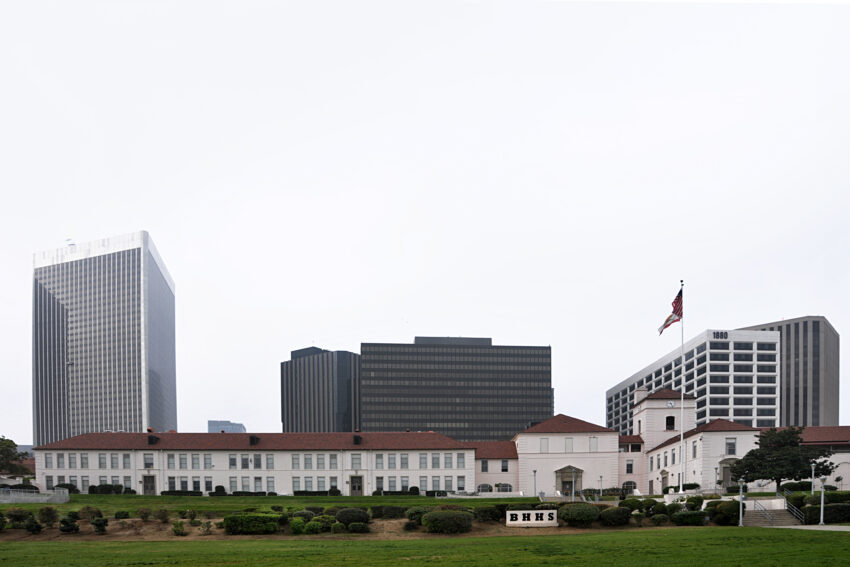
BEVERLY HILLS, CA — The Beverly Hills Unified School District operates five schools for roughly 3,074 students, and its longest-running local argument has been about how to pay for them.
This is one of the wealthiest small cities in California. That wealth shapes the schools through an unusual funding rule. It also fueled more than a decade of fights over permits, budgets, and a subway tunnel.
The district at a glance
| Founded as a unified district | March 23, 1936 |
| Schools | Three elementary, one middle, one high school |
| Enrollment | 3,074 (2023-24) |
| Teachers | 206.06 (full-time equivalent) |
| Superintendent | Alex Cherniss |
| NCES district ID | 0604830 |
The elementary district joined the Los Angeles high school system in 1921. It unified on its own in 1936, the year it added high school operations. The district now serves the entire city of Beverly Hills, a 5.71-square-mile community of about 32,700 residents at the 2020 census.
Three elementary schools, a middle school, and a high school make up the system. Each campus traces its own history, and each has felt the squeeze of a smaller student body. Two are among the oldest schools in Los Angeles County.
The district redrew its grade spans in 2019, moving the elementary schools to kindergarten through fifth grade. Beverly Vista then became the district’s only middle school. District offices sit at 624 North Rexford Drive.
Five campuses, and a shrinking map
The three elementary schools are El Rodeo, Hawthorne, and Horace Mann. El Rodeo opened in 1927 and enrolls 743 students on Whittier Drive. Horace Mann opened in 1929 and enrolls 723 students on Charleville Boulevard.
Horace Mann has earned the California Distinguished School Award four times, most recently in 2008. Its first classes met in December 1929 with 307 students and 11 teachers. The school was dedicated in March 1930.
Hawthorne was the oldest of the three. It opened in 1914 and occupied most of the 600 block of North Rexford Drive. The district held its final classes there on June 1, 2024, as students moved to a rebuilt El Rodeo.
Beverly Vista Middle School, founded in 1924, now serves grades six through eight. It enrolls 723 students on South Elm Drive and earned a National Blue Ribbon Award in 2005. The district dedicated its current classroom building in 2007.
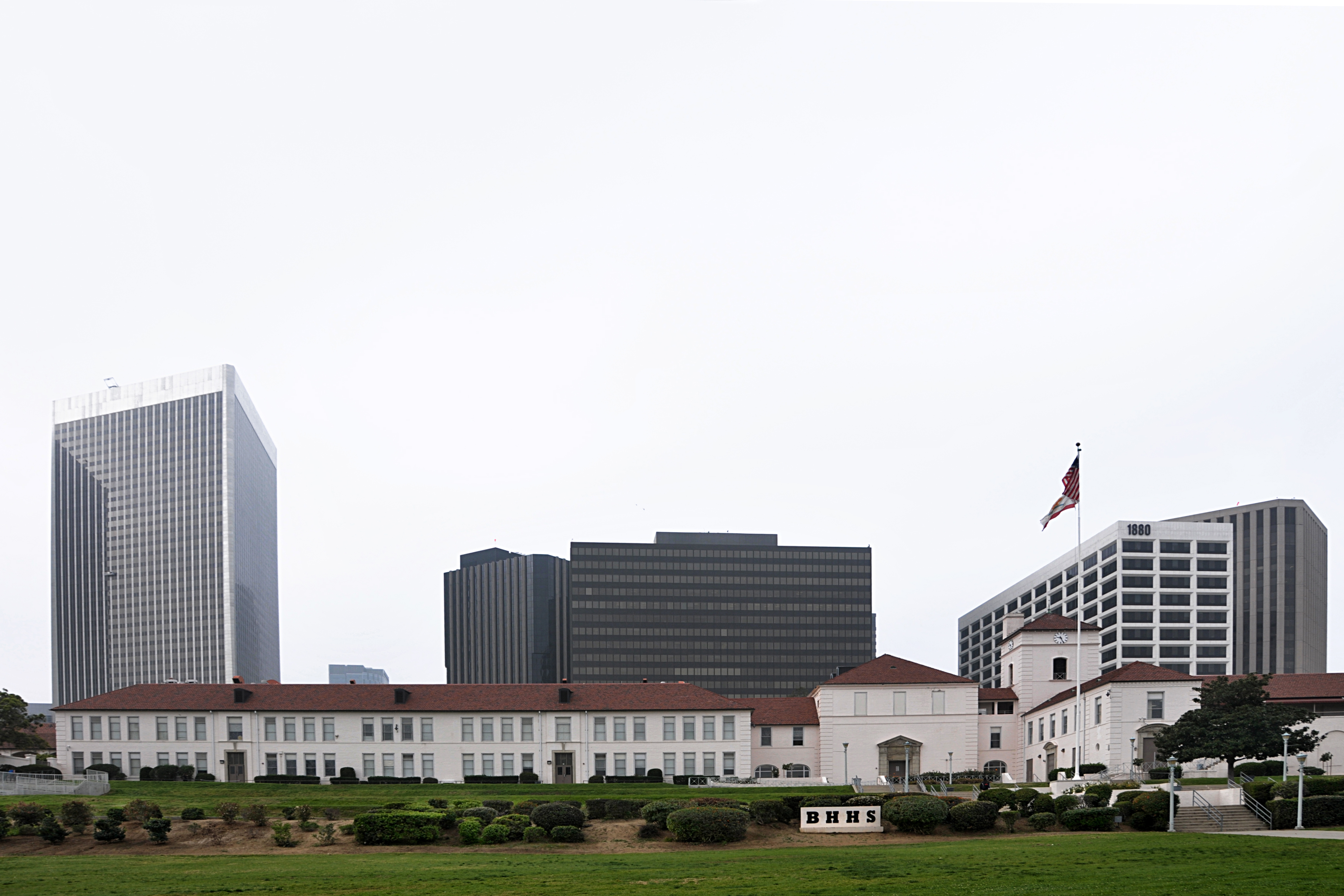
Beverly Hills High School serves grades nine through twelve and enrolls 1,178 students. The campus covers 19.5 acres near the Century City border, on land that once held the Beverly Hills Speedway. It sits over an old oil field and once drew income from an on-campus oil tower.
That high school enrollment figure was 2,412 in 2008, more than double today’s count. The decline is the thread that runs through nearly every budget debate the district has had since.
Basic aid, and who gets a seat
In 2010 the district adopted a “basic aid” funding formula. Under that model, local property taxes cover school costs, so the district keeps its property tax revenue instead of leaning on state per-pupil funds. High home values make that math work here.
Only a small share of California districts qualify for this model. It ties school revenue to local property values rather than to enrollment, which cuts both ways for Beverly Hills.
The same year, the district ended its Diversity Permit program and began turning away out-of-district students. That 2010 change stirred local controversy. The multicultural program had accepted about 30 students each year, and its end shifted the student body.
Permits stayed contested. In 2007, under pressure from civil rights advocates, officials extended the deadline for diversity permit applications. In 2012 the board voted to stop issuing new inter-district permits for the coming year.
The rules remain tight today. Inter-district enrollment is limited to children of city and district employees, plus a small number of grandchildren of residents. Most basic aid districts in California offer no student permits at all.
The subway fight and $15 million in bond money
The district’s costliest battle was over a subway. Los Angeles Metro planned to tunnel its D Line extension beneath Beverly Hills High School. The district and the city opposed the route for years, citing tunnel safety, seeping fumes, and earthquake risk.
The litigation cost more than $15 million, much of it drawn from school improvement bonds. A citizens’ oversight committee questioned that use of bond money. A federal judge ultimately ruled for Metro, and the project moved forward.
The district also appealed to federal officials in Washington, asking them to cut funding for the project. That effort did not change the ruling.
“Beverly Hills oversight committee questions use of $15M in bond money to fight Metro’s subway to the Westside.”
Headline, Curbed Los Angeles, July 29, 2019
The district has also drawn scrutiny for spending outside the classroom. A former superintendent, Robert Pellicone, was fired after a Los Angeles Times report that he ran up bar and hotel tabs on a district card.
Security is another recurring cost line. The city ended its school resource officer program, and the district then tried to hire armed guards. That vendor filed for bankruptcy the same year, and the district hired a new security contractor in 2018.
What residents watch next
Enrollment is the pressure point. The student count has slipped as the city ages, and fewer students can mean tighter budgets even in a wealthy town. Bond debt from the subway fight and campus rebuilds still runs through district ledgers.
The district’s cultural history is tied to its demographics. By 1990 about 20% of students were Iranian, and Nowruz is a school holiday. A five-member board of education, elected by residents, oversees the budget and holds public meetings on a bimonthly schedule.
Each spring the board adopts a budget, and each year the enrollment projection frames the debate. The five schools remain the city’s largest public commitment, and its most argued one.
Five schools. One district. A funding model built on local property wealth. That structure has shaped every fight over money here, and the enrollment numbers will keep the question open.
Sources
- Wikipedia, “Beverly Hills Unified School District”: https://en.wikipedia.org/wiki/Beverly_Hills_Unified_School_District
- Wikipedia, “Beverly Hills High School”: https://en.wikipedia.org/wiki/Beverly_Hills_High_School
- Wikipedia, “Beverly Hills, California”: https://en.wikipedia.org/wiki/Beverly_Hills,_California
- National Center for Education Statistics, district detail for Beverly Hills Unified (ID 0604830): https://nces.ed.gov/ccd/districtsearch/district_detail.asp?Search=2&ID2=0604830
- Beverly Hills Unified School District: https://www.bhusd.org/
- Curbed Los Angeles, “Beverly Hills oversight committee questions use of $15M in bond money to fight Metro’s subway to the Westside” (July 29, 2019).