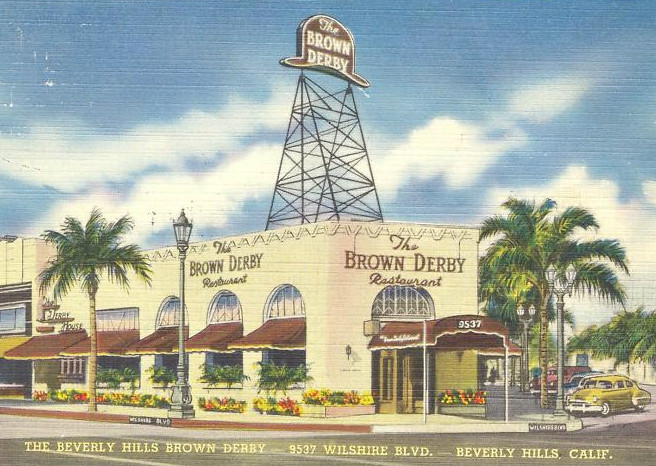
BEVERLY HILLS, CA — The restaurant that helped put this city on the map opened in 1931 at 9537 Wilshire Boulevard.
It was the Beverly Hills branch of the Brown Derby, opened by Bob Cobb across from the Beverly Wilshire Hotel. The building had just been a women’s clothing store called The Petite Shop. The chain had begun in 1926 with a restaurant shaped like a derby hat. Programmatic architecture was in fashion, and that hat was built to catch the eye of passing motorists.
The Derby Brought the Crowds to Wilshire
The Beverly Hills room added touches the town had not seen before. It held the first revolving door in Beverly Hills and a uniformed doorman. A 1938 expansion brought a bar and a private dining room in Old English style, called The Derby House.
One dining area, The American Room, hung charcoal portraits of Academy Award-winning actors by the artist Nicholas Volpe.
The Derby name also carries the Cobb salad. The dish is said to have been thrown together at the Hollywood branch on Vine Street for the showman Sid Grauman. He had just had dental work and could not chew well, so it was chopped fine.
The Shirley Temple drink was invented at the Derby in the mid-1930s. The actress never cared for it and noted that her name had been used without permission.
The Beverly Hills Derby closed in 1982. The building came down soon after. In 1986 a developer bought the empty lot to build the One Rodeo shopping development.
Chasen’s Fed the Stars and Sent Chili to Rome
Chasen’s opened in December 1936 at 9039 Beverly Boulevard, on the border of Beverly Hills. The comedian Dave Chasen started it on the advice of the director Frank Capra. Capra had to lend him silverware to get the doors open.
The room began as a shack. It became famous for chili, and for the people who ate it.
Elizabeth Taylor had orders of that chili flown to the set of Cleopatra in Rome in 1963. Chasen’s was the site of the Academy Awards party for years. Regulars had booths named for them, including Frank Sinatra, Alfred Hitchcock, James Stewart, and Groucho Marx.
Ronald Reagan proposed to Nancy Davis in his Chasen’s booth. That booth is now on display at the Ronald Reagan Presidential Library.
The restaurant did not take credit cards. Known customers signed for their charges and had a bill mailed to them.
Chasen’s closed on April 1, 1995. A Bristol Farms grocery store went up on the site. Its cafe still holds some of the original booths and paneling.
Lawry’s and Perino’s Kept the Old Guard Fed
Lawry’s The Prime Rib opened in 1938 on La Cienega Boulevard, on the stretch locals call Restaurant Row. Lawrence L. “Lawry” Frank and Walter Van de Kamp opened it. They built the menu around one entrée: standing rib roast, carved at the table from a metal cart.
The spinning salad has come with every meal since opening day. So has the seasoned salt the founders first mixed for their earlier restaurant, the Tam O’Shanter.
The orange “L” logo arrived in 1959, designed by Saul Bass.
In 1956 Lawry’s fed both Rose Bowl teams. That dinner grew into the annual Lawry’s Beef Bowl.
The restaurant moved across La Cienega in 1947. Its new home was a windowless modern building by Wayne McAllister. In 1993 it moved into a new building on the original site.
Lawry’s still stands in Beverly Hills, run by the founders’ families. The seasoned salt line was sold to Lipton and later to McCormick.
Perino’s kept its own table just east on Wilshire, inside Los Angeles. Alexander Perino opened it in 1932. He charged $1.25 a dish at a time when that was steep. His clientele ran to Mae West, Cary Grant, Joan Crawford, and Marilyn Monroe.
Frank Sinatra played the piano in the bar. Cole Porter wrote songs on the backs of menus. The menu ran to 150 entrées and 270 wines.
The best service is that which is never seen.
Perino’s house credo
Perino’s closed in 1986. The building was demolished in 2005.
Spago Made an Old City Young
Wolfgang Puck opened the first Spago in 1982 on the Sunset Strip in West Hollywood. It was his first restaurant. The name is Italian for string or twine, a nod to spaghetti.
A Beverly Hills Spago opened in 1997 on Canon Drive. Zagat named it the most iconic restaurant in Los Angeles in 2013. It held two Michelin stars in 2008 and 2009.
Puck let the original Hollywood lease expire in 2001. The Canon Drive room, with its courtyard, carried the name forward.
| Restaurant | Opened | Address | Known for | Status |
|---|---|---|---|---|
| Brown Derby | 1931 | 9537 Wilshire Blvd | First revolving door in town, doorman | Closed 1982 |
| Chasen’s | 1936 | 9039 Beverly Blvd (border) | Chili, star booths | Closed 1995 |
| Lawry’s The Prime Rib | 1938 | 100 N. La Cienega Blvd | Tableside prime rib, spinning salad | Open |
| Perino’s | 1932 | 3927 Wilshire Blvd (Los Angeles) | 150 entrées, 270 wines | Closed 1986 |
| Spago | 1982 (Beverly Hills: 1997) | 176 N. Canon Dr | California cuisine | Open |
The most iconic restaurant in the city of Los Angeles.
Zagat, 2013, on Spago
What the Tables Said About the City
Read the rooms together and a pattern shows up.
The Derby pulled in passing traffic with a building shaped like a hat. Then it added the small luxuries of a modern city: a revolving door and a doorman. Chasen’s turned dinner into a private club, with chili worth flying across an ocean.
Lawry’s sold tradition, one cut and one salad kept for decades. Spago sold newness, a young chef who put California cooking on a plate.
Each said something about Beverly Hills in a different way. This is a city people come to be seen, and to be fed while they are seen.
Rodeo Drive would later define the address. Long before Rodeo, the restaurants did.
Sources: Wikipedia, citing the Los Angeles Times, the New Yorker, the Beverly Hills Weekly, and L.A.’s Legendary Restaurants (Geary, 2016).