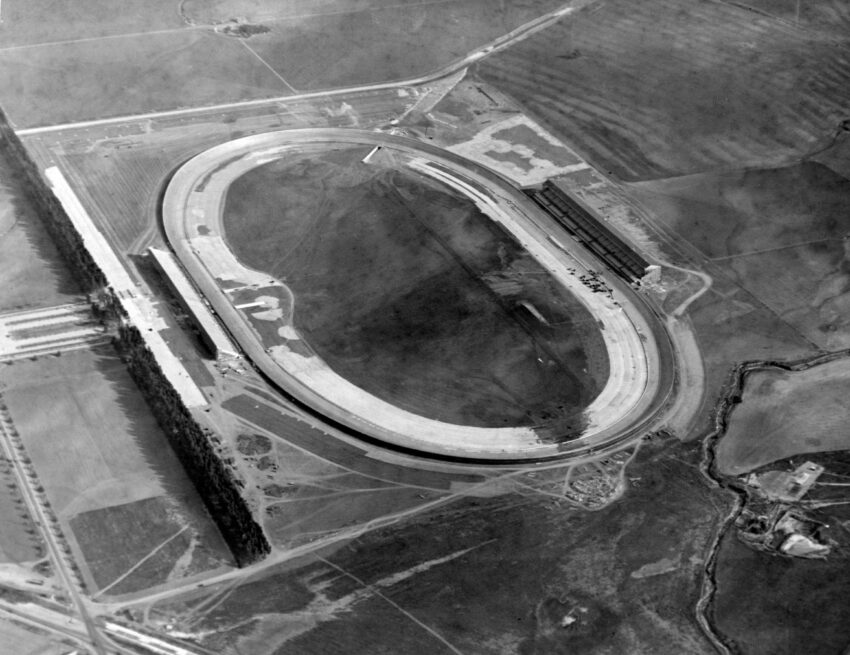
BEVERLY HILLS, CA — For four years in the 1920s, the fastest race cars in America ran in circles on a wooden track in Beverly Hills.
The track drew crowds that filled a stadium. It also killed a national champion.
Then the land got too valuable to keep, and the whole thing came down.
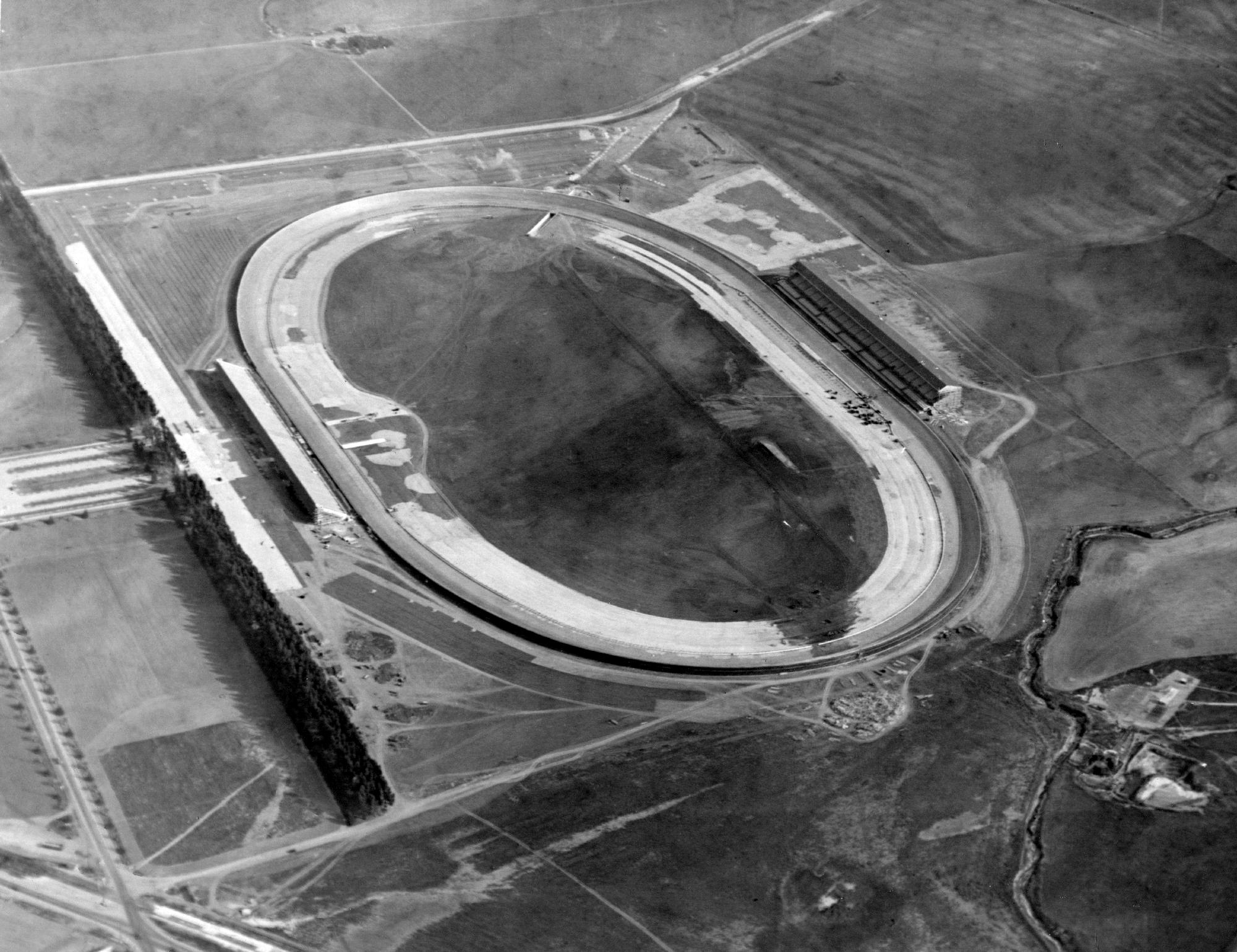
Its story starts in a bean field.
A racetrack in the bean fields
Beverly Hills had been a city only since 1914. Most of the flat land south of Wilshire still grew crops.
The town began when a group of investors drilled for oil and found water instead. They built a city on the land.
In 1919, a group of racers and businessmen bought 275 acres from a bean farmer. They paid $1,000 an acre.
The ground came out of the old Rancho Rodeo de las Aguas, the Mexican-era grant that once covered the whole area.
They called themselves the Beverly Hills Speedway Association. Eleven men were in it, and the roster carried weight.
Cliff Durant was the son of General Motors founder William C. Durant. William Danziger came from the Rodeo Land and Water Company, which held much of the town. Louis Meyer would later win the Indianapolis 500 three times.
The land covered the block now bounded by Wilshire Boulevard, South Beverly Drive, Olympic Boulevard, and Lasky Drive.
That put it right outside the Golden Triangle, the shopping district that grew up around Rodeo Drive.
The fastest track in the nation
Wooden board tracks were not new. The Los Angeles Motordrome in Playa del Rey was the first purpose-built track of its kind. It drew paying crowds for two years before a fire destroyed it.
The Speedway Association wanted something faster. It hired Jack Prince, a British former bicycle racer who had built velodromes.
Prince could build. He knew little about engineering.
The association’s civil engineer, Art Pillsbury, borrowed a method from the railroads. The turns used a Searle Spiral Easement Curve, which leans a car into the bank one step at a time.
No track in the United States had been laid out that way before. The turns let drivers keep speed where a plain oval would slow them.
The results showed on opening day in 1920. Jimmy Murphy averaged more than 103 miles per hour over 250 miles.
Indianapolis would not see a time trial that fast until 1923. Fifty thousand people came out to watch the race.
The Speedway hosted the opening and closing rounds of the national championship for its first three seasons. Drivers like Ralph DePalma and Tommy Milton found their way to the boards.
Death on a Thanksgiving afternoon
Speed at that level came with risk. The wooden boards offered little room for error.
On Thanksgiving Day in 1920, Gaston Chevrolet and Eddie O’Donnell collided on the track. Chevrolet had won the Indianapolis 500 that year.
Both drivers died. Chevrolet’s riding mechanic, Lyall Jolls, died a day later.
Chevrolet was named national champion for 1920 after his death.
The races continued. The Speedway also drew horse shows and film crews.
Four seasons later, the last race drew 85,000 people into a 70,000-seat stadium. Harlan Fengler won the 250-mile main event at an average of 116.6 miles per hour.
That set a world record for the distance.
Where the track stood
The oval covered 275 acres on the block bounded by Wilshire Boulevard, South Beverly Drive, Olympic Boulevard, and Lasky Drive. That ground now holds the Beverly Wilshire hotel and the streets south of it.
The Golden Triangle shopping district sits on the north and east edges of the old speedway land.
The land outgrew the track
The Speedway drew well. Even so, the track became an uneconomical use of the property.
Real estate values in Beverly Hills climbed through the early 1920s. Land that cost $1,000 an acre in 1919 sold for $10,000 an acre five years later.
Price of the Speedway land, per acre
The association sold the property to a developer and took the wooden oval apart board by board. The final checkered flag had flown on February 24, 1924.
Some race programs billed the place as the Los Angeles Speedway.
It was a 70,000-seat stadium, gone in a single four-year run.
Racing moved a few miles south to Culver City, where the association built a new track south of the MGM studios.
The city that replaced the track had changed fast. We told the earlier part of that story in our account of how Beverly Hills became a city.
The hotel that replaced it
Developer Walter G. McCarty built the Beverly-Wilshire Apartment Hotel on the old speedway land. It opened on January 1, 1928, when the city had fewer than 18,000 residents.
The building went up in Tuscan stone and Carrara marble, in an Italian Renaissance style, shaped like a blocky E.
It rose over the track’s northwest turn. A few years later the name shortened to the Beverly Wilshire Hotel.
The hotel grew into a landmark of its own. Paul Revere Williams, a noted African American architect, led renovations between 1946 and 1957. The hotel added a ballroom, an Olympic-sized pool, and tennis courts run by champion Pancho Gonzalez.
Around it, the Golden Triangle grew into a shopping address known around the world. Rodeo Drive became its spine, a story we covered in our look at the street’s three blocks.
The speedway’s four years left little behind but the block it shaped. No grandstand stands, no board survives.
What it left was a lesson about land in a small, wealthy city. The fastest track in the country could not outrun its own address.
| Beverly Hills Speedway at a glance | |
|---|---|
| Opened | 1920 |
| Closed | 1924 |
| Length | 1.25 miles |
| Surface | Wooden boards |
| Seats | 70,000 |
| Site | 275 acres |
| Land price, 1919 | $1,000 an acre |
| Land price, 1924 | $10,000 an acre |
| Stands today | Beverly Wilshire hotel |
Sources: Wikipedia’s entries on the Beverly Hills Speedway, the Beverly Wilshire Hotel, and Beverly Hills, California. Those entries cite the San Diego Air & Space Museum, the USC Digital Library, and the Los Angeles Public Library photo collection, among others.