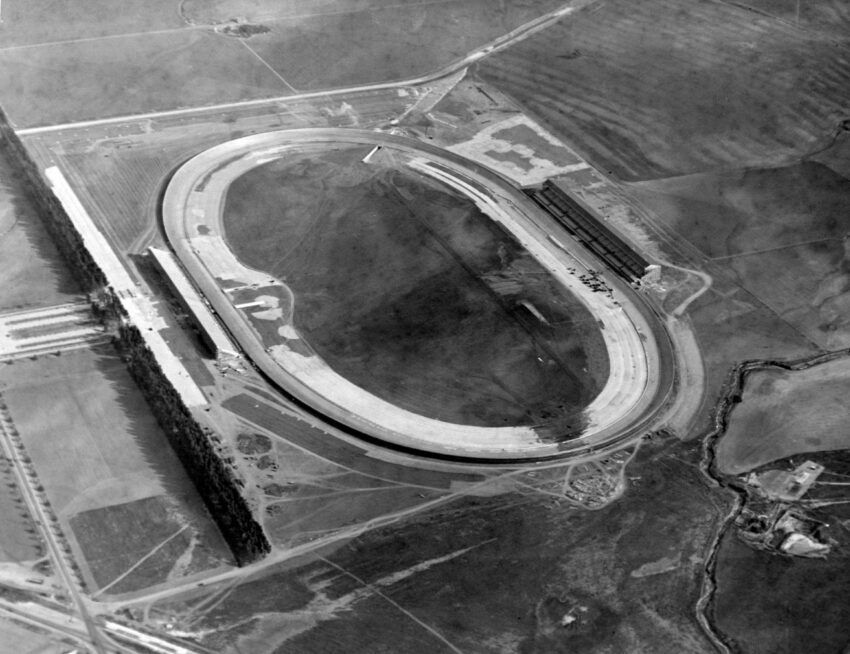
BEVERLY HILLS, CA — Before the boutiques, before the palm trees had a reputation, this city had a speedway. It sat on 275 acres of flat farmland just outside today’s Golden Triangle. For four years it was the loudest place in the county.
The track opened on Feb. 28, 1920. It was gone by 1924, torn down for the dirt it sat on.
What replaced the boards explains this city better than any postcard. The land became Beverly Hills High School, the Beverly Wilshire, and the shops that line South Beverly Drive.
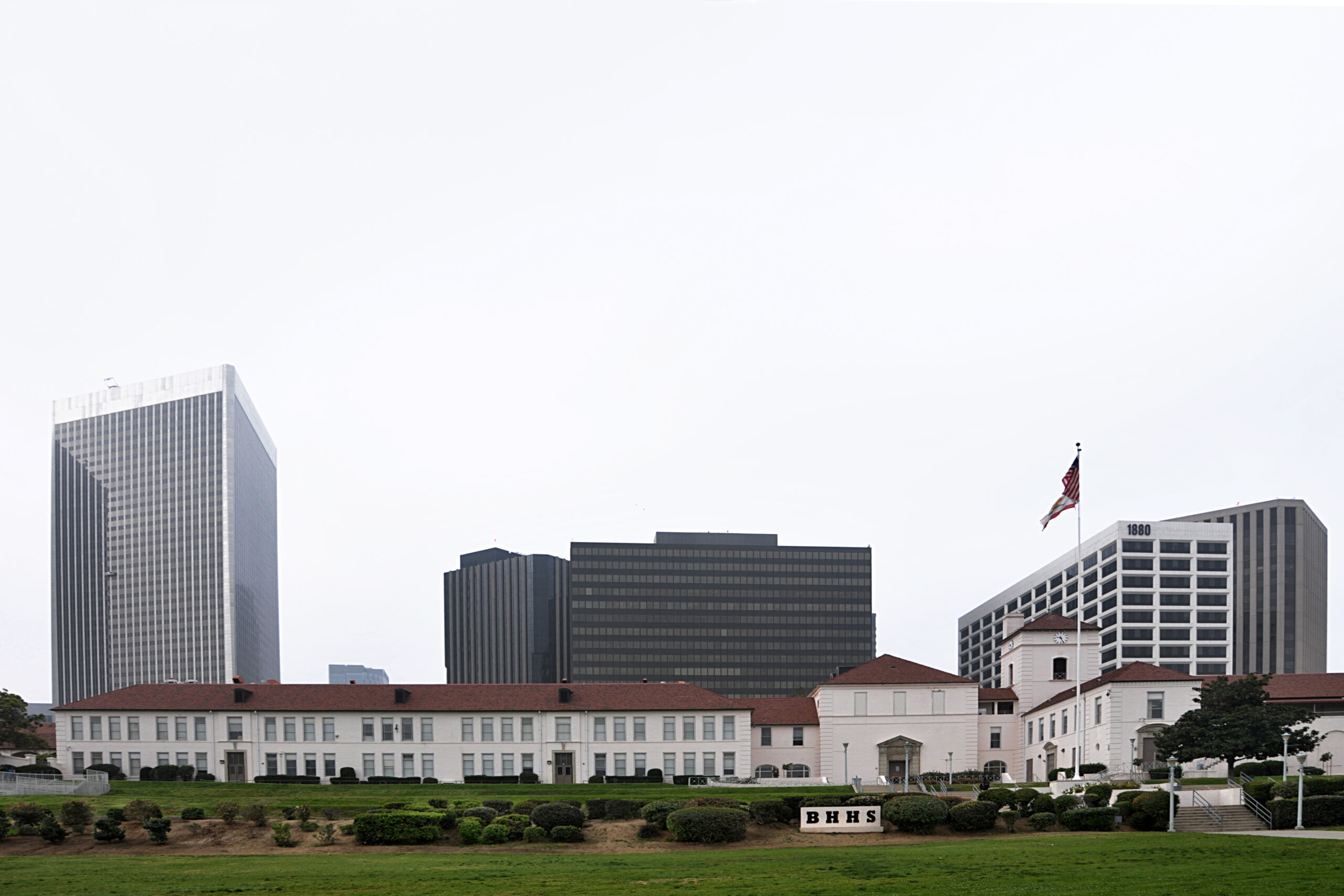
Walk past the school on a weekday and the hillside gives nothing away. The grass is quiet, the courts are quiet, and nothing about a Tuesday morning there says seventy thousand.
The track was a wooden board oval, 1.25 miles around, with four banked turns. Engineers tilted the curves at 37 degrees so the cars could hold the line at speed.
At night the headlights swung around those turns like searchlights. You could hear the engines from blocks away, long before you saw the boards.
A racetrack on bean fields
The land was still farm country when a group of racers bought it. The city’s visitors bureau notes that the speedway drew crowds from 1919 to 1924, watching daring motor races on its wooden track.
By the account kept by racing historians, the buyers paid a bean farmer about $1,000 an acre and waited for his harvest to come in. The farmer got his crop. The racers got their track.
The backers were drivers and businessmen chasing speed, not a civic monument. Among them was Cliff Durant, the son of General Motors founder William C. Durant.
They called themselves the Beverly Hills Speedway Association. The group included a partner from the Rodeo Land and Water Company, the outfit that had laid out the young town.
They broke ground in 1919 and built quickly. By the next winter the little city had a stadium it had never asked for.
Beverly Hills, barely five years old, said yes.
The fastest mile and a quarter
The design was unusual for its day. It was the first track in the country to bank its turns using a technique borrowed from the railroads. The trick eased cars from the straightaway into the curve.
Board tracks were fast and unforgiving. The planks warped in the sun, splinters flew, and a car that lost a wheel rarely stopped at the rail.
On race day the grandstands filled. The noise rolled across the open fields toward the hills, and the town that owned the track collected the crowd.
The entry lists read like a roll of early American racing. Ralph DePalma and Tommy Milton both drove here, and Louis Meyer, a future three-time Indianapolis winner, helped found the association.
Crowds that size made the speedway the young town’s first real attraction. Admission was cheap, the parking was a field, and the whole thing sat a short walk from the still-unpaved heart of the city.
At the opening race, Jimmy Murphy averaged better than 103 miles per hour across 250 miles. That pace made the Beverly Hills oval one of the quickest in the nation.
For a few seasons, this was the place to be seen going very fast.
The Beverly Hills Speedway, at a glance
- Opened: Feb. 28, 1920
- Closed: 1924
- Length: 1.25 miles
- Surface: wooden board track
- Turns: four, banked 37°
- Land: 275 acres
- Site today: Beverly Hills High School, the Beverly Wilshire, and South Beverly Drive shops
A champion dies, and the dirt gets expensive
The track’s luck turned in 1920. Gaston Chevrolet, the reigning Indianapolis 500 champion, was killed in a crash there that fall. He had won at Indianapolis only months earlier.
The bigger pressure came from the ground itself. As the city filled in around it, the acres under the track were worth far more as real estate than as a racetrack.
Land here did not stay cheap for long. The same decade the track opened, the town was already selling itself as a place to live rather than a place to watch.
Board tracks were a national fad, and a brief one. Built fast in the 1910s and 1920s, most were gone within a decade, outlived by the land they stood on.
By 1924 the math was settled. The association tore down the boards and moved its racing operation a few miles away to Culver City.
| Year | Milestone |
|---|---|
| 1919 | Land bought and ground broken |
| Feb. 28, 1920 | Track opens; Jimmy Murphy wins the 250-mile race |
| 1920 | Gaston Chevrolet killed in a crash |
| 1924 | Track torn down; racing moves to Culver City |
What the track left behind
The speedway’s footprint is now some of the most valuable ground in the region. The Beverly Wilshire, a Four Seasons hotel, stands at Wilshire and Beverly, on land the track once ringed.
The high school took much of the rest. Generations of students have crossed a campus built on an old racing oval, most of them never knowing it.
The old straightaways are buried under pavement now. Wilshire Boulevard runs thick with traffic where cars once ran flat out on wood.
The Golden Triangle that grew up beside it never looked back. The blocks that ringed the old oval are the ones tourists photograph today. The flat ground the racers picked is the ground everyone else wanted.
That is how this city buries its history — under something more profitable.
The pattern set in 1924 has repeated ever since. A famous thing gets built, the land beneath it grows valuable, and the famous thing gives way to something quieter and richer.
The city’s long habit of trading spectacle for land value is told in From Lima Beans to Landmark. The school that rose on the old track has its own chapter in Five Schools, One District.
The speedway lasted four years. The lesson it left lasted a century.